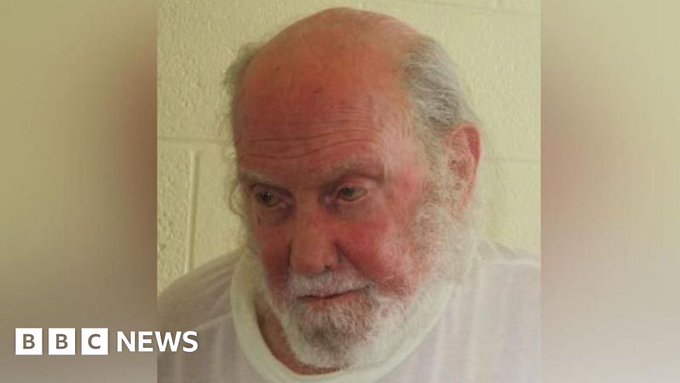
(US prisoner, Francis Clifford Smith Photo Credit: BBC News)
Francis Clifford Smith, a US prisoner who escaped eight execution dates and served more than 70 years in jail, died on Wednesday at the age of 101.
At the age of 25, Smith was found guilty of first-degree murder in Connecticut in 1950, although he insisted on his innocence the entire time he was incarcerated.
In 1949, he was charged with the murder of Grover Hart, a nite watchman at a yacht club in Connecticut.
One of the two individuals detained in connection with the murder was Smith, but the other took a plea deal and testified against him.
Smith was later found guilty and given the death penalty.
But as time went on, questions regarding his conviction surfaced. Later, witnesses withdrew their claims, and another prisoner admitted to the crime.
The Board of Pardons was later informed by one of the officers who questioned Smith following his detention that he thought Smith was innocent.
According to the Boston Globe, Major Leo Carroll stated, “I’m not even sure he was present at the murder.”
Before his execution was finally avoided, Smith was served a final dinner on each of his eight execution dates.
With the exception of three brief periods of freedom, he was incarcerated for more than 70 years.
Smith broke out of prison in 1967, but he was apprehended again 12 days later.
He was permitted to leave prison on Christmas Eve in 1974 and returned the next day.
In 1975, he was given release; however, approximately ten months later, he was caught for violating his parole by possessing a weapon and committing small-time theft.
Smith later turned down multiple requests to be placed back on parole, according to Richard Sparaco, a former executive director of Connecticut’s Board of Pardons and Paroles.
However, Smith was given supervised parole in 2020 and relocated to an assisted living facility.
Smith earned the nickname “The Birdman of Osborn” because he frequently fed birds while incarcerated, according to Andrius Banevicius, public information officer for the Connecticut Department of Correction.
Banevicius claimed, “He would stuff as much bread as he could, in his clothing.”
“Everyone kind of turned a blind eye to it because they knew he was just feeding the birds.”
Smith eventually moved to 60 West, a nursing facility providing care to incarcerated and formerly incarcerated people.
David Skoczulek, a spokesman for the facility, said Smith died in his sleep in June and was later cremated.
“Essentially, he died of old age,” Skoczulek said. “He had very limited family involvement around his passing, but we assured it was appropriate, met his wishes and was dignified.”
Researchers say Smith’s case also highlights the growing challenge of caring for an ageing prison population in the US.
Dr Stephanie Prost, a researcher specialising in older adults and prison settings at the University of Louisville, said many prison systems face similar challenges.
“We’re not the only jurisdiction that’s facing that ageing-related crisis, because similar issues are percolating in Australia and England,” she said.
“It’s an international issue in terms of the population. Although, of course, we have a larger number of individuals in the US.”
A 2025 study found that the number of people aged 55 and older in US prisons increased by nearly 400% between 1991 and 2021.
Researchers have called for measures such as compassionate release and elderly or medical parole to help address the needs of ageing prisoners.
Research has also found that imprisonment can contribute to “accelerated ageing”, with some health conditions developing earlier among people who have spent long periods in prison.
According to Skoczulek, a person’s health may be significantly impacted by prolonged incarceration.
“We often say that someone who has been incarcerated for a long time can be sixty years old and have the health of a ninety-year-old,” he stated.
Banevicius did not corroborate reports that Smith suffered from dementia near the end of his life.
According to Banevicius, “He was 101 and a half.” “In terms of longevity, he did pretty well.”