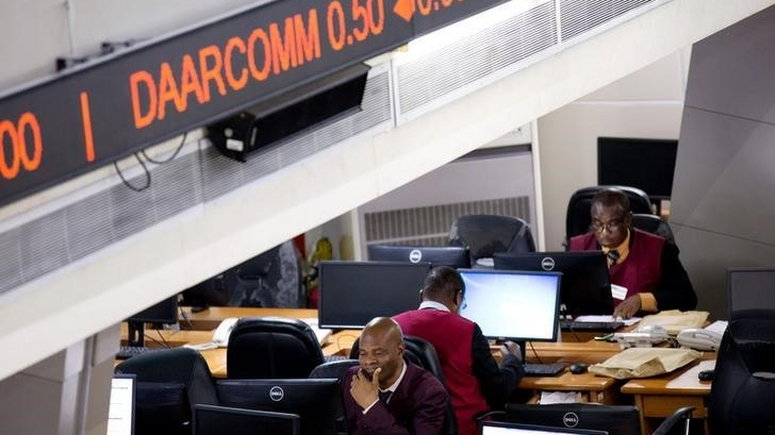
The rally that has lifted Nigerian equities by almost 60 percent this year showed further signs of losing momentum last week as selling pressure spread across the Nigerian Exchange Limited (NGX), pushing 54 stocks lower and dragging the banking sector down 2.64 percent.
The NGX All-Share Index fell 0.97 percent to 248,363.55 points in the week ended October 9, 2026, from 250,808.27 points a week earlier.
That wiped 2,444.72 points off the benchmark index, while equity market capitalisation declined by the same 0.97 percent to N161.260 trillion.
More significant than the headline index decline was the deterioration in market breadth.
Only 24 equities appreciated during the week, while 54 declined and 68 remained unchanged. In the preceding week, 44 stocks had gained against 37 decliners and 65 unchanged stocks.
This means the number of gainers fell by about 45 percent week-on-week, while decliners increased by almost 46 percent.
For every stock that advanced last week, approximately 2.25 stocks declined, showing that the weakness was spread well beyond a handful of large-cap companies.
Banking Stocks Come Under Pressure
Banking stocks, which have played a major role in driving both liquidity and investor activity on the NGX, were among the sectors caught in the selloff.
The NGX Banking Index declined 2.64 percent to 2,614.79 points during the week and was down 3.59 percent since the beginning of October.
The weakness is notable because financial services continued to dominate trading activity.
Investors traded 2.005 billion financial-services shares worth N82.924 billion, accounting for 73.84 percent of total equity volume and 52.39 percent of market value.
Access Holdings, Zenith Bank and United Bank for Africa alone accounted for 1.020 billion shares worth N50.520 billion, equivalent to 37.56 percent of total market volume and 31.92 percent of transaction value.
Heavy trading activity therefore did not translate into broader strength for banking equities.
Fidelity Bank illustrated the pressure within the sector, falling 10.64 percent from N23.50 to N21 during the week.
Oil and Gas Leads Sector Decline
The weakness extended beyond banks.
Oil and gas stocks recorded the steepest sector decline, with the NGX Oil/Gas Index falling 3.85 percent during the week.
The Commodity Index lost 2.86 percent, the Pension Index declined 2.12 percent and the Lotus II Index fell 2.01 percent.
The NGX Growth Index also declined 1.97 percent, while the Insurance Index lost 1.74 percent.
Industrial Goods was the major exception, edging 0.02 percent higher during the week.
The breadth of those declines reinforces the picture of a market experiencing broader profit-taking rather than weakness confined to a single sector.
Market Still Sitting on Huge 2026 Gains
The latest decline, however, has to be viewed against the scale of the rally already recorded in 2026.
Despite falling 0.97 percent last week, the All-Share Index remained 59.60 percent higher year-to-date as of October 9.
Several sector indices were sitting on even larger gains.
Oil and gas, despite leading last week’s decline, remained 124.92 percent higher year-to-date, while the Premium Index had gained 102.66 percent.
Industrial Goods was up 83.96 percent, the Pension Index 82.43 percent and the Banking Index 72.50 percent.
The market’s October performance, however, suggests some of that momentum is being tested.
The All-Share Index was down 1.13 percent month-to-date, while Banking had lost 3.59 percent and Oil and Gas was down 3.86 percent since the beginning of the month.
Investors Trade Fewer Shares but Commit More Money
Trading data provided another important signal.
Investors exchanged 2.715 billion shares worth N158.280 billion in 209,986 deals during the week.
In the preceding week, 3.166 billion shares worth N155.023 billion had changed hands across 206,662 deals.
Therefore, while trading volume declined about 14.2 percent, transaction value increased approximately 2.1 percent, or N3.26 billion.
The number of deals also increased about 1.6 percent.
This combination shows that the market remained highly active even as share prices weakened and fewer units changed hands.
Sharp Reversals Emerge
Individual stocks also showed signs of rapidly changing sentiment.
CMFC, which had surged 37.73 percent in the preceding week, plunged 20.27 percent to N3.58 last week, surrendering about 74 percent of the naira gain recorded during its earlier rally.
ABC Transport followed a similar pattern.
After surging 45.10 percent from N5.10 to N7.40 in the previous week, the stock declined 18.24 percent to N6.05.
Aradel Holdings dropped 10 percent to N1,377, while Japaul Gold & Ventures declined 11.11 percent.
Yet the selloff was far from universal.
Livestock Feeds surged 47.75 percent to N13.15, Tripple Gee gained 32.62 percent, Guinea Insurance advanced 29.17 percent and Learn Africa appreciated 19.61 percent.
These sharp gains alongside a deteriorating overall market suggest that investor interest has not disappeared but has become increasingly selective.
NGX Rally Faces an October Test
The emerging picture is therefore not one of an inactive market.
Liquidity remains substantial, transaction value increased, financial stocks continued to attract significant turnover and several individual equities recorded double-digit gains.
What changed was the breadth and direction of price movement.
The shift from 44 gainers and 37 losers in the preceding week to just 24 gainers against 54 losers last week represents a clear deterioration in market participation on the upside.
At the same time, weakness in Banking, Oil and Gas and several other major indices left Industrial Goods virtually alone in positive territory.
After a 59.60 percent year-to-date increase in the All-Share Index, the question heading deeper into October is whether the latest losses represent a temporary consolidation following the strong 2026 rally or the beginning of a more sustained moderation in Nigerian equity valuations.