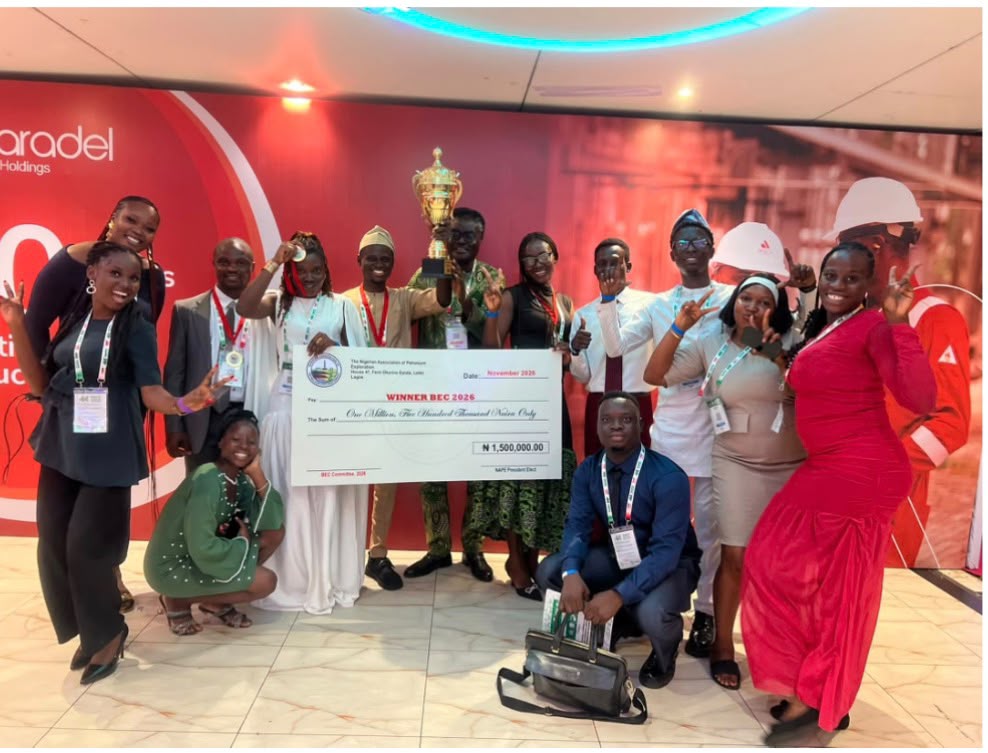
Ekiti State University, EKSU, Ado-Ekiti, has emerged overall champion of the Nigerian Association of Petroleum Explorationists, NAPE, Basin Evaluation Competition, defeating other participating institutions, including the University of Lagos and the University of Ibadan, to clinch the top position in its maiden appearance.
The achievement marks a significant milestone for the university’s Department of Geology, particularly amid ongoing efforts to strengthen its academic capacity, research facilities and practical exposure to the petroleum industry.
In a press release, the Deputy Director and Head of the Directorate of Information and Corporate Affairs of the university, Peter Olatunde Ọmọtayo, described the achievement as a reflection of the department’s growing academic strength and the impact of sustained investment in its development.
Ọmọtayo noted that the accomplishment aligns with a five-year development vision established by the university’s Chancellor, Dr Tunji Olowolafe, to position the Department of Geology among the best in Africa. He said the vision was being pursued through improved learning facilities, research support, professional exposure and institutional commitment.
The Vice-Chancellor, Professor Joseph Babatola Ayodele, congratulated the Head of the Department of Geology, Professor Adeyinka Aturamu, and the victorious team, led by Makanjuola Peteru Ayomide and Adeniyi Favour, for bringing honour to the university. He also commended the Chancellor and acknowledged the support received towards the development of the department.
Professor Aturamu also expressed appreciation for the support provided to the department, particularly the upgrade of its workstation and the provision of internet facilities, which he said had significantly strengthened its research capabilities.
A major aspect of the department’s development has been the improvement of its teaching and research infrastructure, supported by the Tunji Olowolafe Foundation. The interventions include an 11-seater bus, five high-performance computers with monitors, a large-format colour poster printer, a fifth-generation HP laptop, colour printing and photocopying equipment, a 6.2KVA inverter with solar panels, a 55-inch Hisense smart television, a projector for postgraduate lectures and Starlink internet connectivity.
Beyond infrastructure, efforts have also been made to expose students and lecturers to developments in the petroleum industry through participation in professional conferences, training programmes and other academic engagements.
In 2025, six students and two lecturers from the department attended the NAPE Mini Conference at Kwara State University through sponsorship support, where EKSU finished fourth. This was followed by the participation of eight students and a lecturer at the 44th NAPE Conference in Lagos.
The Head of the Department of Geology, Professor Adeyinka Aturamu, also received sponsorship to participate in a leadership programme at the National Institute for Policy and Strategic Studies, NIPSS, Abuja.
According to Ọmọtayo, these interventions form part of a broader effort to equip the department with the resources, professional exposure and academic environment required to compete favourably with leading institutions.
He noted that EKSU’s emergence as overall champion in its maiden appearance at the NAPE Basin Evaluation Competition was particularly remarkable, given the calibre of institutions that participated. The performance, he said, underscores the importance of combining sound academic instruction with practical exposure and access to appropriate learning resources.
The victory is expected to further enhance the profile of EKSU’s Geology programme, stimulate greater interest in petroleum geology and encourage the department to pursue higher standards in research, innovation and professional training.
For the university, the achievement represents more than a competition victory. It is an encouraging indication that sustained investment in academic development, effective institutional leadership and strategic partnerships can translate into tangible results.