
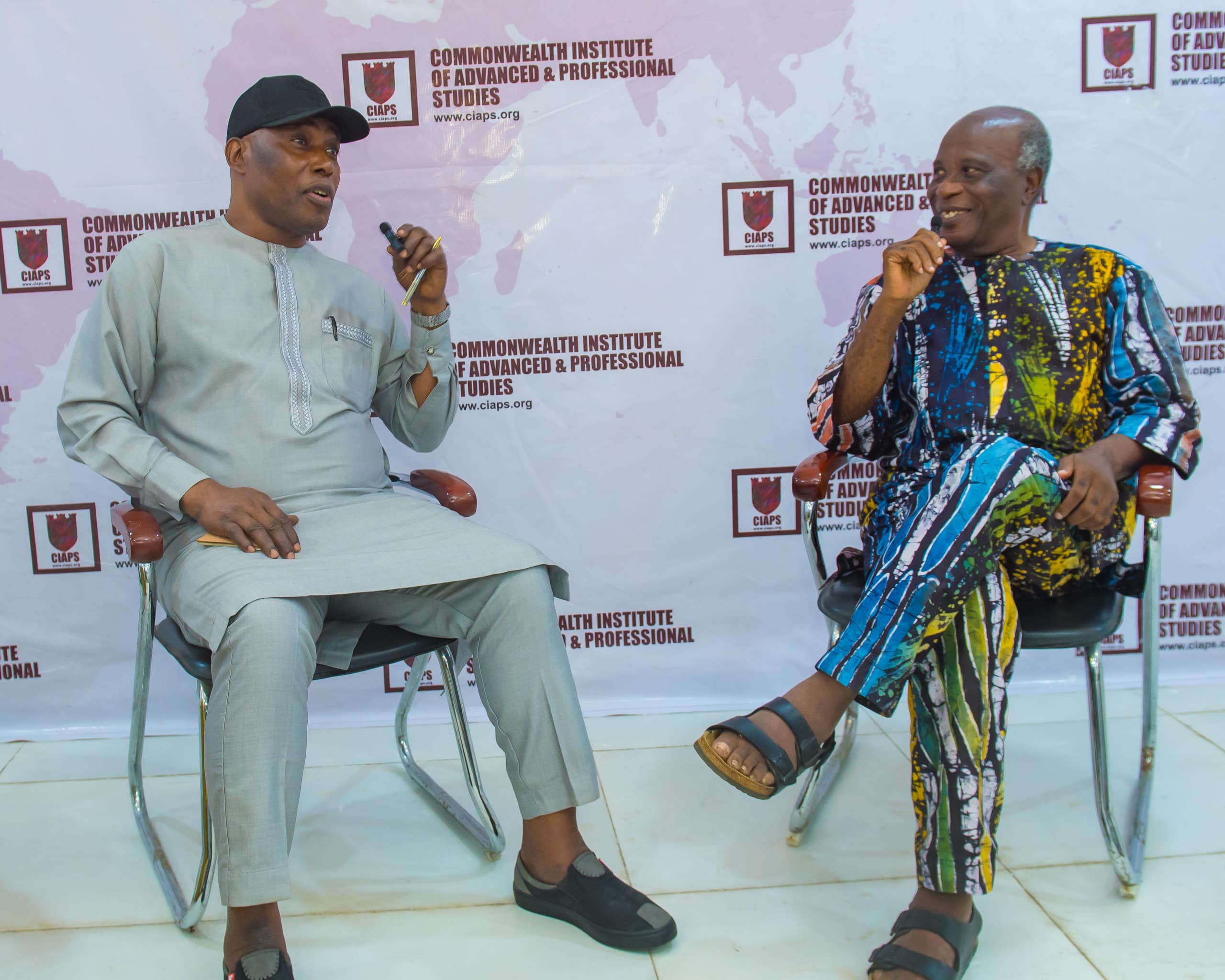
Professor Adebayo Lamikanra has revealed how his father’s insistence that he look beyond the arts and explore the sciences ultimately shaped his unconventional career as a pharmacist, scholar, writer, poet, sportsman and public intellectual.
Lamikanra, a distinguished, retired Nigerian Professor of Pharmacy at the Obafemi Awolowo University (OAU), Ile-Ife, spoke at the “Meet-the-Author” session held during the unveiling of his books, Talking Points and The Rise and Rise and Rise of Capitalism, at the CIAPS Auditorium, Akinola Cole Crescent, off Adeniyi Jones, Lagos, on August 11, 2026. He was responding to a question from former Managing Director of The Guardian, Martins Oloja, on whether he would have chosen the social sciences if he had the opportunity to live his life again.
The professor said he would still choose the same path because diverse interests, including sports, literature, science and public affairs, had shaped his life. “I was more of a cricketer than anything else,” Lamikanra said, recalling that he once dreamt of becoming a professional cricketer. He added that, at the time, virtually everyone, including himself, expected him to pursue the arts.
However, his father challenged that expectation. “Everybody expected me to go into the arts, including myself. But somehow, my father challenged me seriously. He said, ‘Bayo, if you know you are good, why would you think you should restrict yourself to history and literature? Why don’t you do some biology, some this, some that?’”
According to Lamikanra, the pressure eventually became so intense that he decided to take up the challenge, joking that if he failed, his father would have to take responsibility. “I decided, okay, when I fail, it will be your fault. To my surprise, I did it,” he said.
The decision eventually led him into the sciences and, subsequently, pharmacy. Yet Lamikanra explained that his scientific training never extinguished his passion for literature and sports. “I was surprised when I went into the science class and started writing, and people were taking me seriously as a scientist. How can anyone think I am a scientist? But then, when I started, I went to a pharmacy. But I read more books of literature than books of pharmacy,” he said.
His passion for sports also remained strong, even during his postgraduate days. Lamikanra recalled that he became so immersed in British sports that one of his external examiners from Britain once wondered whether he had travelled to England to obtain a pharmacy degree or study British sports. “He looked at me and said, ‘Did you come to England to get a degree in pharmacy or UK sports?’ I said both,” he recalled humorously.
Lamikanra also attributed an important part of his intellectual development to his education at Igbobi College, Lagos, saying the school instilled in him the principle that “merit must rule.” He recalled that he developed a deep love for reading while at the school, where he had access to a library and would often borrow a book almost every day.
“I did not know then that I was making a wave,” he said, adding that although his academic grades were initially not impressive because of his interest in other activities, his performance eventually improved.
He described passing the entrance examination to Igbobi College, Lagos as a turning point in his life. “When I passed that terrible exam to Igbobi College, I think that my life was settled. From then on, I have been confident that Igbobi College will not ever let me down,” he said.

The conversation also touched on Lamikanra’s long association with Nigerian journalism and his contributions to public debate, particularly through The Guardian. Oloja recalled Lamikanra’s spirited exchanges with Catholic Bishop Hassan Kukah in the newspaper, which at one point became a sustained public controversy.
Lamikanra explained that many of the essays contained in Talking Points were written between 1992 and 1995, a period he described as one of the most turbulent in Nigeria’s history. He said he wrote regularly for The Guardian but was not a columnist at the time, and later contributed to other newspapers after the government shut down the newspaper house. Some of his writings from the period, he noted, have since been lost.
Reflecting on his philosophy, Lamikanra said merit remains one of the central principles guiding his life and work. As a lecturer, he said, he believed students who deserved to succeed should succeed, while those who did not deserve to pass should fail. “If you deserve something, you should get it. If you do not, it’s a tragedy,” he said.
The professor also expressed concern about the decline of Nigerian journalism, education and intellectual engagement, arguing that the press was considerably more rigorous and influential several decades ago. He recalled that he began reading newspapers as early as the age of seven, when his uncle would return from work with a copy of the Daily Times. According to him, that early exposure to newspapers helped shape his intellectual curiosity and later drew him into public arguments on national issues.
Lamikanra also said his writings in Talking Points remain relevant because many of the problems he identified in the 1990s persist today. He cited the theft of bridge railings and other infrastructure as an example, saying he had written about the disappearance of railings from a bridge on the road to Ife in 1992. “I was not being prophetic. I was just saying the things that I saw, and the consequences, or the likely consequences, of what we are going to have to deal with,” he said.
He also criticised the declining quality of public discourse and education, particularly the inability of many young Nigerians to communicate effectively in English or indigenous languages. Lamikanra argued that language, education and intellectual discipline were essential to leadership, warning that a leader who could not communicate ideas effectively would lose the authority expected of the position.

The discussion later moved to The Rise and Rise and Rise of Capitalism, with Lamikanra explaining that the title was deliberately sarcastic. “Capitalism is now so huge that we look at it, and we can’t go round it,” he said, adding that he believed the world could be better organised around socialist principles because of the importance of fairness. He criticised the growing gap between the rich and poor, arguing that capitalism had created enormous wealth for a small group while millions remained trapped in extreme poverty.
Lamikanra also challenged African leaders to rethink the continent’s educational system and relationship with the outside world. He argued that despite Africa’s enormous natural resources, the continent remained economically dependent and vulnerable.
He particularly stressed the importance of preserving African languages and cultural confidence, warning that abandoning indigenous languages was part of a wider loss of confidence in Africa’s ability to determine its own future.
For Lamikanra, however, education remains the most important route to rebuilding society. He argued that Nigeria must revive public education, restore teacher-training institutions and ensure that education produces citizens prepared not merely to provide for themselves and their families but to serve their communities.
He recalled that both his parents were teachers at a time when teachers commanded considerable respect in society.
“That level of education is what you need to come back,” he said. “Discipline, discipline, discipline through education.”
Lamikanra said his commitment to education was also reflected in his continued interest in Igbobi College and the quality of education it provides. He argued that Nigeria must rediscover the principle of identifying and nurturing talented young people, as was done in earlier generations. “We must pick,” he said repeatedly, recalling how passing the Igbobi College entrance examination had changed the course of his own life.
He also warned against turning education into an avenue for personal entitlement, saying those who benefited from society’s institutions should see their education as a responsibility to serve others. “Let us train people not so that they can provide for themselves and their families, but so that they can serve the community,” Lamikanra said.

The professor, who has continued writing since he retired from academic life, said he had no intention of abandoning the written word. “When I’m happy, I write. When I’m angry, I write. When I’m hungry, I write,” he said. Lamikanra noted he had also come to recognise himself as an introvert who enjoys his own company, adding that writing and thinking had become natural companions in his retirement.
As Oloja concluded the discussion by describing education as one of the major “talking points” emerging from the session, Lamikanra’s reflections offered a portrait of a career shaped not by a single discipline but by the collision of his father’s challenge, his education at Igbobi College, his love of literature and sports, and his lifelong commitment to reading, writing and public engagement.
The Director-General of the Centre for International Advanced and Professional Studies (CIAPS), Prof. Anthony Kila, had earlier in his welcome address described the author as a man of many parts.
The CIAPS boss noted that the author had achieved what many could not: not only writing books but also blending the natural sciences with the social sciences, history, poetry, and literature in a way that awakens and engages readers.
“Today, we are unveiling the books, but it is an opportunity to deepen intellectual discourse and ask the author general questions during the Meet-The-Author session,” he said.
During the book review session, Mr Adeyeun Olusesan described Talking Points as a collection of 62 essays addressing Nigeria’s politics, governance, law, education and society. He said Lamikanra attributes Nigeria’s underdevelopment to poor leadership, weak institutions and a crisis of values. He praised the book’s clarity, breadth and courage, noting its continuing relevance to Nigeria’s challenges, including corruption and insecurity.
On The Rise, Rise, and Rise of Capitalism, Olusesan said the 21 essays examine capitalism’s impact on poverty, inequality, governance and economic policy. He praised Lamikanra’s accessible analysis and his questioning of who benefits from Nigeria’s economic system. However, he noted the limited discussion of alternatives to capitalism and practical solutions, while still describing the book as an important contribution to Nigeria’s economic debate.
Dr Gideon Ayanrinde, for his part, said Talking Points uses everyday experiences to explore wider issues of discipline, corruption, governance and national development. He praised its treatment of education, leadership, national unity and African identity, while acknowledging that some arguments are opinionated and require stronger evidence.
Reviewing The Rise, Rise, and Rise of Capitalism, Ayanrinde praised its broad historical treatment of capitalism and its focus on Africa. He said the book connects economics with politics and society in accessible language, but recommended stronger references, clearer conceptual distinctions, engagement with opposing views, and more contemporary African evidence. Despite these limitations, he described it as ambitious, provocative, and intellectually engaging.
At the end of the day, it dawned on everyone present that the event was more than an unveiling of two books but also a journey into what shaped the distinguished professor’s life, his multidisciplinary scholarship, and why his ideas remain relevant to this day.
