There is often a lag between exposure and impact in most security incidents. Credentials leak, data circulates, and only later does something visible happen. By the time alerts fire, the useful signal has already been missed.
This is where dark web monitoring becomes less of a feature and more of a habit. The real question is not whether it should be done, but how often should dark web monitoring be performed to actually make a difference.
That answer is rarely static. It shifts with risk, with business model, and with how seriously security is taken inside the organisation.
The Gap Most Teams Underestimate
It helps to think about how leaked data behaves once it leaves controlled systems. It does not immediately land in the hands of attackers who will act on it the same day. Instead, it moves.
Credentials get bundled. Databases get traded. Access gets resold. In some cases, nothing happens for weeks. That delay creates a false sense of safety.
A team might check once a month and feel covered. Yet if compromised credentials were shared two days after the last scan, that exposure sits quietly for weeks. Enough time for lateral movement, privilege escalation, or even resale to a more capable threat actor.
This is why the discussion around how often dark web monitoring should be performed needs to move beyond arbitrary schedules.
Frequency Depends on Exposure, Not Comfort
There is a tendency to align monitoring frequency with operational convenience. Weekly sounds reasonable. Monthly feels manageable while quarterly often gets approved without debate.
But none of these are rooted in actual risk.
A SaaS company handling user logins, payment data, or API keys carries a very different exposure profile compared to a small internal system with limited external access. The volume and sensitivity of data dictate how often should dark web monitoring be performed, not the size of the team or available tools.
Industries like finance, healthcare, and e-commerce tend to see faster data circulation once a breach occurs. That shortens the window between leak and exploitation.
In such environments, anything less than continuous monitoring starts to look inadequate.
Continuous Monitoring is not Overkill
There is still resistance to the idea of continuous dark web monitoring. It is often viewed as excessive or resource heavy. In practice, it is closer to baseline.
Threat actors do not operate on schedules. Markets on the dark web are active around the clock. New data appears constantly, sometimes in bits and pieces that only make sense when correlated over time. Periodic scans miss that progression.
Continuous monitoring, when done properly, is not about generating constant alerts. It is about maintaining visibility. It allows security teams to detect early signs, even when the data is incomplete or seemingly low impact.
When considering how often should dark web monitoring be performed, the more accurate question becomes whether gaps in visibility are acceptable at all.
What Happens When Monitoring is Too Infrequent
The consequences of low-frequency monitoring rarely show up immediately. They surface later, often in ways that seem disconnected from the original leak.
A reused password appears in a credential stuffing attack. An exposed email list becomes part of a phishing campaign. Admin access gets quietly sold and used weeks later. By then, tracing back to the original exposure becomes difficult.
This is where many organisations realise that their approach to how often should dark web monitoring be performed was based on assumptions rather than evidence.
Monitoring once a month may technically tick a compliance box. But it does very little to reduce actual risk.
Signals to Pay Attention To
Not all dark web findings carry the same weight. Frequency alone does not solve the problem if the signals are misunderstood or ignored.
There are certain patterns that matter more:
- Repeated appearance of the same domain across different dumps
- Fresh credential sets with valid formats
- Mentions of internal systems or access points
- Data tied to privileged accounts
These are not rare occurrences. They appear regularly in active threat environments.
Frequent monitoring increases the chance of catching these signals early, before they evolve into something more damaging.
This is another reason why the frequency of dark web monitoring cannot be treated as a static decision.
Monitoring Frequency Breakdown
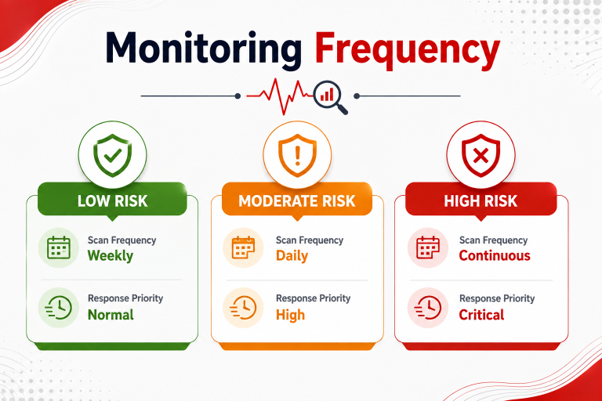
A simple way to visualise monitoring frequency is to map it against risk exposure. This structure often helps internal teams align on expectations. Below is a practical breakdown.
1. Low Risk
Used where exposure is minimal and data sensitivity is limited.
- Monthly scans
- Manual review of findings
- Basic alerting
This is often seen in small organisations or isolated systems. It works, but only within narrow boundaries.
2. Moderate Risk
Applies to businesses with customer data, employee credentials, or external integrations.
- Weekly automated scans
- Alert prioritisation
- Integration with incident response workflows
At this level, the question of how often should dark web monitoring be performed, starts to shift towards automation rather than manual effort.
3. High Risk
Typical for finance, healthcare, SaaS platforms or any environment handling sensitive or high-value data.
- Continuous monitoring
- Real-time alerts
- Correlation with internal security tools
- Rapid response playbooks
Here, anything less than continuous visibility introduces unnecessary blind spots.
Why Automation Changes the Answer
The availability of automated monitoring tools has quietly altered expectations.
In the past, the question of how often should dark web monitoring be performed was constrained by human effort. Analysts could not realistically scan forums, marketplaces, and dumps every day. That limitation no longer holds.
Modern monitoring systems aggregate data, track changes and surface relevant findings without constant manual input. This allows for continuous monitoring without overwhelming the team.
As a result, sticking to weekly or monthly checks is less about practicality and more about outdated thinking.
The Human Factor Still Matters
Even with automation, interpretation remains critical. Not every alert requires action. Some require context. Others need correlation with internal logs, user behaviour, or access patterns.
There is a tendency to overreact to any mention of company data on the dark web. That leads to noise, fatigue, and eventually missed signals.
On the other hand, ignoring subtle indicators because they seem incomplete can be equally risky.
Finding the balance takes time. It also reinforces why how often should dark web monitoring be performed is only part of the equation. The quality of response matters just as much.
Compliance Versus Actual Security
Certain frameworks and regulations touch on monitoring requirements, but they rarely define meaningful frequency. This creates a gap.
An organisation might meet compliance expectations while still operating with significant exposure. Monthly reporting may satisfy auditors, yet attackers continue to exploit leaked data in between those checks.
Security teams that treat compliance as the upper limit often end up reacting rather than anticipating. The discussion around how often should dark web monitoring be performed needs to move beyond compliance checklists. It should reflect actual threat behaviour.
When To Revisit Your Monitoring Frequency
Even a well-defined approach should not remain fixed.
There are clear moments when frequency should be reassessed:
- After a security incident
- During rapid business growth
- When entering new markets
- After adopting new technologies or integrations
- When threat intelligence indicates increased targeting
Each of these shifts the risk profile. Ignoring these changes often results in monitoring practices that lag behind reality. And that gap is where problems start.
Conclusion
There is no single number that answers how often should dark web monitoring be performed. The closer answer is this: as often as necessary to remove blind spots.
For most organisations handling sensitive data, that points towards continuous monitoring. Because anything less leaves too much unseen for too long.
The real value lies in early detection. Catching exposed credentials before they are used. Identifying patterns before they escalate. Acting before damage spreads. This is where structured support makes a difference.
CyberNX provides expert dark web monitoring services with the help of experienced professionals and cost-effective plans. They can give you a full picture of your security, including any vulnerabilities, dark web behaviours and the risks that come with them.
Because knowing how often should dark web monitoring be performed is only useful when the answer leads to action.