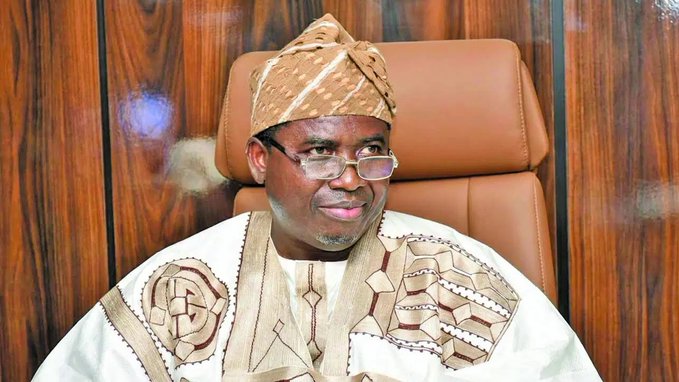
(Professor Joash Amupitan. Photo by Vanguard News)
In order to prepare for the 2027 General Election, the Independent National Electoral Commission, or INEC, has announced intentions to hold a mock accreditation procedure in November 2026.
While hosting a delegation from the Canadian High Commission on a courtesy visit to the commission’s offices on Friday, INEC chairman Professor Joash Amupitan, SAN, made this revelation.
According to Amupitan, the purpose of the exercise is to strengthen the integrity of the ballot during the general election by putting the Bimodal Voter Accreditation System (BVAS) through a rigorous field test.
“Mock accreditation will be conducted in November 2026 to evaluate our preparedness for the general election,” he declared.
To strengthen the integrity of the ballot during the election, we will put our electoral apparatus, the Bimodal Voter Accreditation System (BVAS), through a thorough field test.
We will value your cooperation in making this mock accreditation a success.
The head of INEC reiterated that the Governorship and House of Assembly elections are scheduled for February 6, 2027, while the Presidential and National Assembly elections are scheduled for Saturday, January 16, 2027.
He stated that “enhancing voter participation, ensuring the security of the ballot, and building public trust in the electoral system” were among the common priorities that the Commission was still committed to.
Before the fake accreditation and the actual general election, Amupitan used the Osun State governorship election on Saturday, August 15, 2026, as a test of the Commission’s operational preparedness.
He stated, “Osun showed what is possible when administrative foresight meets technological fortitude through early morning logistics deployment where 3,556 out of 3,763 Polling Units (94.5%) opened for accreditation and voting precisely by 8:30 a.m. optimal BVAS field performance, seamless result upload on the IReV portal, and proactive crisis management.”
The Commission saw Osun’s accomplishment “not as a final destination, but as the gold standard that will guide our preparations for 2027,” he continued.
He pointed out that the Commission had joined presidential candidates on Tuesday, August 18, 2026, when the National Peace Committee signed the First National Peace Accord on Issue-Based Campaigns, and that Wednesday, August 19, 2026, was the official statutory start of public campaigns and rallies for the 2027 General Election.
Speaking further about the extent of the Commission’s preparations for the upcoming elections, Amupitan revealed that INEC would deploy a workforce of about 1.4 million ad hoc workers across more than 176,000 Polling Units nationwide, calling it “one of the largest mobilizations of human resources for a national assignment in our country’s history.”
The INEC Chairman listed strategic priorities under discussion with the Canadian delegation to include consolidating technological gains, deepening electoral inclusivity for Persons with Disabilities (PWDs), women and youth, institutional capacity building, and countering misinformation ahead of the 2027 polls.
Additionally, he revealed that the Commission has set up a special Artificial Intelligence Unit to deploy technology for voter registration, data management, and results transmission while preventing its abuse.
According to Amupitan, INEC is excited to take part in the Global Conference on Responsible AI and Elections, which will take place in Ottawa, Canada, from 9th to 11th September 2026 , and is being organized by Elections Canada and the United Nations Development Program (UNDP).
While assuring the international community of the Commission’s impartiality, he asked Canada for assistance in expediting the INEC delegation’s visa procedure for the Ottawa session.