
By Isa Isawade
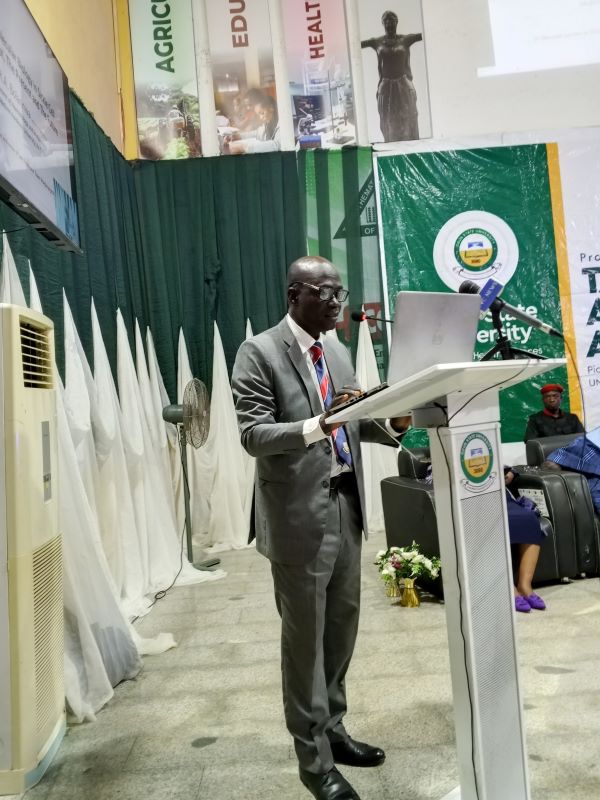
The Olagunsoye Oyinlola Auditorium at Osun State University’s Osogbo Campus buzzed with quiet reverence on Thursday as the institution gathered to honour a man whose footprints remain indelible on its soil. The 3rd Biennial Lecture in memory of Professor Taiwo Adegboyega Adewole drew dignitaries from across Nigeria—family members, academics, traditional rulers, and students. All united by a shared purpose: to celebrate, in the words of Vice-Chancellor, Prof. Clement Odunayo Adebooye, a life that left the world better than it met it.
A Foundation of Excellence
Professor Adewole was no ordinary academic. His credentials read like a roadmap of relentless pursuit of knowledge: B.Sc in Biochemistry from the University of Ibadan (1974), PhD in Biochemistry from Obafemi Awolowo University (1982), MBBCh from the University of Calabar (1985), and Fellowship of the West African College of Physicians in Laboratory Medicine (1996). He was the pioneer Provost of UNIOSUN’s College of Health Sciences—the man who laid the bricks upon which the institution’s medical programme now stands.
“Someone who started the College of Medicine in this university is being remembered for the good that he did,” declared the Vice Chancellor in his address. “The university, in recognition of his input and delivery, decided that every year we must remember this man. He left the society better than he met it.”
The Lecture: Hope for Sickle Cell Warriors
This year’s lecture focused on immunobiology and sickle cell disease—a topic deeply connected to Professor Adewole’s pioneering work. The guest lecturer, Professor Rahman Ayodele Bolarinwa, a researcher of international repute, delivered a masterclass on the intersection of molecular genetics and sickle cell disease.
Nigeria, he reminded the audience, remains the global epicentre of sickle cell disease. With 4 to 6 million Nigerians living with the condition and 20 to 25% carrying the trait, the burden is staggering. Yet amidst this sobering reality, hope emerged through science.
Professor Bolarinwa traced the remarkable journey of prenatal diagnosis in Nigeria, a foundation laid by Professor Adewole and his colleagues.
In a landmark study, they analysed 124 DNA samples using PCR-RFLP technology, confirming hemoglobin SS in 23 cases (18.5%) through chorionic villi sampling as early as six to ten weeks in utero.
“This was the first ever study to use molecular biology tools to establish prenatal diagnosis for sickle cell disease in Nigeria,” Professor Bolarinwa emphasised. “It is this foundation that other studies are building upon in this country.”
The Seed That Refused to Die
Perhaps the most poignant moment of the ceremony came when Vice Chancellor Adebooye recounted the tumultuous history of UNIOSUN’s medical programme—a story of near-destruction and miraculous resurrection.
According to Prof. Adebooye, “In 2011, the medical programme was abruptly cancelled by words of mouth pronounced by the then Governor of Osun, Ogbeni Rauf Aregbesola. Students who were ready to advance to clinical stages were instead farmed out to Ukraine at enormous cost. Professor Adewole and his colleagues fought valiantly but could not rescue the programme at that time.

“The seed that Professor Adewole sowed, the seed that he laboured to nurture, someone decapitated it but did not uproot it from the ground. The stump of the tree sprouted and has yielded fruit for the very first time.
“That fruit was realised in 2018 when the programme was revived. Recently (August 2026), for the first time in Nigerian medical education history, 90 medical doctors were inducted at once—the pioneer set of medical students from UNIOSUN.
“If my enemy is going to attack me, the only thing he should just do is to let my stump remain. Perhaps there will be that opportunity for me to regrow.”
A Life of Service and Sacrifice
The story of Professor Adewole extends far beyond university corridors. Born on August 26, 1949, in Osubu, Ejigbo.
According to citation of the late professor read at the event, he remained deeply committed to his hometown even as his star rose nationally. His first building outside his office was erected not in the state capital but in Ejigbo, where he actively participated in community development committees.
At the Nigerian Institute of Medical Research (NIMR), he established the first research medical laboratory for HIV/AIDS treatment—reputedly the third largest in Nigeria with over 100 staff members. As founder and head of the clinical sciences department, he was among the first clinicians to harmonise HIV treatment in Nigeria, contributing significantly to national scale-up.
His faith was equally central to his identity. A born-again Christian and committed leader, he served as medical team leader for the Christian Surgical Mission—judged three times as the best medical team in Nigeria—and chaired the medical board of the Nigerian Baptist Convention.
Yet for all his professional achievements and international recognition, those who knew him best remember a gentle soul who loved music, sang hymns with devotion, and played the piano with remarkable dexterity. He was a devoted husband to his wife, Deaconess Keji Adewole, for 38 years, and a loving father to Prince Adedokun Adewole, Prince Adeoye Adewole, and Princess Mrs Oluwasayo Adewole (daughter-in-law).

A Call to Action
As the ceremony drew to a close, the Vice Chancellor challenged everyone present with a question that lingered in the air: “What legacy are you going to leave behind?”
The answer, he suggested, lies in preserving values, building upon achievements, and continuing the work begun by pioneers like Professor Adewole. With one of Nigeria’s best teaching hospitals and world-class laboratories at its disposal, UNIOSUN is committed to advancing research in sickle cell disease, building on the points raised by the guest lecturer.
“The best way to honour our pioneers,” the Vice Chancellor reminded the audience, “is not merely to remember them, but to preserve their values, build upon their achievements, and continue the work they began.”
In honouring Professor Taiwo Adegboyega Adewole, Osun State University did more than remember a departed scholar. It reaffirmed its commitment to the ideals he embodied: excellence, service, integrity, and innovation. And in doing so, it ensured that his legacy would continue to inspire generations yet unborn.
