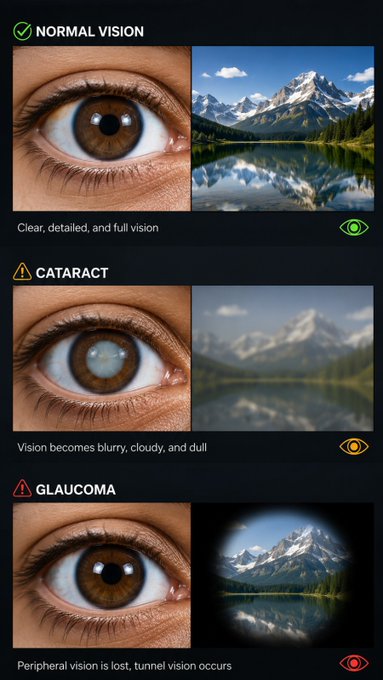
(Different Sight. Photo by Save Sight Centre)
Cataracts are the most common cause of blindness in Jigawa State, accounting for 40.8% of cases, according to a state-wide eye health survey.
Dr. Tafida Abubakar, an eye expert, presented the survey results on Tuesday during a Rapid Assessment of Avoidable Blindness (RAAB7) dissemination meeting in Jigawa State.
The results showed that trachomatous and other corneal opacities caused 21.1% of instances of blindness, while glaucoma accounted for 23.6%.
Complications from cataract surgery made up 8.3%.
According to the survey, the overall prevalence of bilateral blindness was 2.9%, affecting an estimated 19,638 people, whereas the prevalence of unilateral blindness was 3.9%, affecting an estimated 27,026 people.
With an estimated 36,623 patients making up the cataract surgery backlog, it also revealed a substantial burden of cataracts requiring surgical intervention.
The results also showed that Jigawa had a cataract surgery coverage rate of 34.9%, which is far below than the WHO’s recommended minimum of 80%.
Nonetheless, the survey found that 90.8% of cataract procedures utilizing intraocular lenses resulted in visual acuity of at least 6/18, meaning that the majority of patients who had surgery had good eyesight.
The poll suggested improved glaucoma case-finding and management, as well as more cataract surgery services in terms of volume, quality, and fair access.
Additionally, it urged for expanding refractive error services, paying more attention to corneal illnesses, and raising community knowledge to remove obstacles that keep locals from receiving eye care services.
In response, Dr. Kainuwa, the State Commissioner for Health, reaffirmed the state government’s initiatives to enhance the state’s eye healthcare system.
He claimed that the state government, working with partners, has treated approximately 11,900 individuals with preventable illnesses related to blindness during the previous two years.
He noted that the state government was also working to make all primary eye-care services free to reduce the prevalence of avoidable blindness in the state.