By Ibrahim Bakare
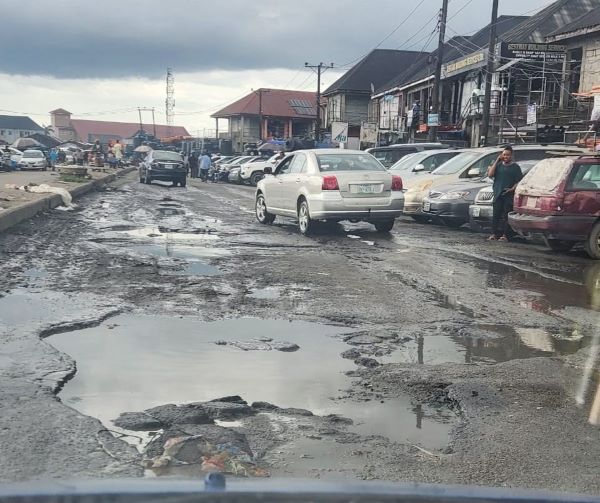
For years, motorists, residents, business owners and other road users along the Iwofe–Epirikom axis of Port Harcourt, Rivers State have endured a road that appears to be deteriorating faster than the authorities are responding.
The question now being asked by residents is simple but important: Who is responsible for the road, and why has the situation been allowed to persist for so long?
The Iwofe–Epirikom Road is located within Obio-Akpor Local Government Area of Rivers State and forms part of the road network serving communities within the Port Harcourt metropolitan area. Available road-location records identify both Iwofe Road and Epirikom Road within Obio-Akpor.
For residents and motorists who use the route daily, however, the more pressing issue is not merely who owns the road, but who is expected to maintain and rehabilitate it.
The road falls within the responsibility of the Rivers State Government through the Ministry of Works and Infrastructure, raising questions about the level of attention being given to a route that serves a large population and supports significant commercial, industrial and educational activities.
A road carrying an important economic burden
The Iwofe–Epirikom corridor is not an isolated rural road. It is part of the expanding Port Harcourt urban environment, linking residential communities with commercial establishments, businesses, industries and educational facilities.
The presence of Ignatius Ajuru University of Education in the wider Iwofe area further underscores the importance of the route. An environmental study, for instance, identified sampling points along Iwofe Road and specifically around Ignatius Ajuru University of Education and Epirikom Road.
This means that students, lecturers, university employees, traders, transport operators, residents and business owners depend on the road every day.
There are also numerous commercial establishments and businesses operating around the corridor. As Port Harcourt continues to expand, the pressure on roads serving these communities can only increase.
Yet, motorists complain that instead of becoming a dependable urban transport corridor, sections of the road have become a source of frustration, vehicle damage and avoidable delays.
The question of the money
Perhaps the biggest question confronting the Rivers State Government is whether the Iwofe–Epirikom Road has been adequately considered in the state’s road-maintenance priorities.
The question becomes more significant when the state’s budgetary provisions for works and infrastructure are examined.
In 2025, the Rivers State budget presented during the period of emergency rule included about N324 billion for infrastructure, according to reports on the budget submitted to the National Assembly.
The situation becomes even more striking in 2026.
Governor Siminalayi Fubara presented a proposed N1.854 trillion 2026 budget, tagged the “Budget of Resilience for Growth and Development.” Of the proposed capital expenditure of about N1.405 trillion, N533.32 billion was earmarked for Works and Infrastructure, the largest sectoral allocation in the capital budget.
The governor said the allocation was intended to support new infrastructure projects, complete ongoing road projects and maintain existing roads and bridges across Rivers State.
That raises an unavoidable question:
If hundreds of billions of naira are being allocated to works and infrastructure, what provision, if any, has been made for the rehabilitation and maintenance of the Iwofe–Epirikom Road?
This is not necessarily an allegation that funds were allocated specifically for the road and diverted. Rather, it is a legitimate accountability question that deserves a clear answer from the Rivers State Government and the Ministry of Works and Infrastructure.
If the road is under the state’s responsibility, residents have a right to know whether it is captured in the government’s road-maintenance programme, whether an assessment has been conducted, whether a contractor has been engaged, and, if so, when physical work is expected to begin.
Motorists count the cost
For motorists who use the route regularly, the condition of the road is more than an inconvenience.
Bad portions of the road can force drivers to slow down suddenly, weave around damaged sections or compete for limited usable space. Such conditions can increase the risk of collisions, particularly during periods of heavy traffic or poor visibility.
Vehicle owners also bear the financial consequences
Frequent passage through potholes and badly damaged portions can contribute to premature wear on tyres, suspension components, steering systems and other vehicle parts. For commercial drivers who depend on their vehicles for daily income, repeated repairs can become a serious economic burden.
A road that should facilitate movement and commerce can therefore become an additional cost on residents and businesses.
When rain comes, the problem gets worse.
Another major concern is drainage.
In a city such as Port Harcourt, where heavy rainfall can quickly expose weaknesses in drainage systems, road construction and maintenance cannot be separated from effective storm-water management.
Where drainage channels are inadequate, blocked or poorly maintained, water can remain on the road and accelerate its deterioration.
The result is a cycle: damaged road surfaces create pools and depressions; stagnant or poorly drained water further weakens the road; motorists struggle to navigate the damaged sections; and the road deteriorates even further.
Residents therefore need more than temporary filling of potholes. What is required is a comprehensive assessment of the road, including its drainage system, road surface, shoulders and other supporting infrastructure.
A corridor that government should not overlook
The Rivers State Government’s own official portal describes infrastructure renewal, including roads and urban renewal across local government areas, as one of its priorities. The state’s Ministry of Works and Infrastructure is specifically responsible for infrastructure and public works development.
That stated commitment should translate into visible improvements on roads such as Iwofe–Epirikom.
The issue is not about politics or partisan interests. It is about whether public infrastructure is delivering value to the people who depend on it.
The state has repeatedly demonstrated that it can undertake major road projects. Its official project records, for example, document the reconstruction of the Egbeda–Omerelu Link Road and describe the project as part of its infrastructure-renewal programme.
Residents along Iwofe–Epirikom are therefore asking why a strategically important road serving communities, businesses and an educational institution should continue to attract complaints without a clearly communicated rehabilitation plan.
The unanswered questions
The situation demands answers from the Rivers State Government and, particularly, the Ministry of Works and Infrastructure.
Is the Iwofe–Epirikom Road included in the state’s current road-maintenance or rehabilitation programme?
Was money specifically provided for the road in the 2025 budget?
Is there a provision for it in the 2026 budget?
Has the Ministry carried out an engineering assessment of the road?
Has any contractor been awarded a contract for its rehabilitation?
If a contract exists, what is its value, when was it awarded and what is the completion date?
If no provision has been made, why has a major road serving residents, businesses and an important tertiary institution been left out of the state’s infrastructure priorities?
These are questions that deserve official answers rather than assumptions.
Rivers Government must wake up
The people using the Iwofe–Epirikom Road are not asking for a favour. They are asking for functioning public infrastructure.
Rivers State has substantial revenues and, according to the figures contained in the 2026 budget proposal, expects significant receipts from FAAC, derivation, VAT and other sources. The proposed 2026 revenue included about N936.05 billion from FAAC allocations, derivation funds, VAT and exchange gains, alongside projected internally generated revenue of N487.61 billion.
With such resources and a Works and Infrastructure allocation of more than N533 billion, residents are entitled to ask whether their roads are receiving a fair share of public investment.
The Iwofe–Epirikom Road should not have to become completely impassable before government acts.
The Rivers State Government should urgently inspect the road, address the most dangerous sections, improve drainage and, where necessary, undertake comprehensive rehabilitation.
For motorists, residents, students, lecturers, workers and businesses along the corridor, the cry is becoming increasingly difficult to ignore.
Who is responsible?
For the people of Iwofe and Epirikom, the answer should not simply be found in an official document. It should be seen on the road—in asphalt, drainage, safe passage and a road that works.
The Rivers State Government must wake up from slumber and respond to the unending cries of the people.